Fifa investigating Argentina over Falklands banner after World Cup semi-final
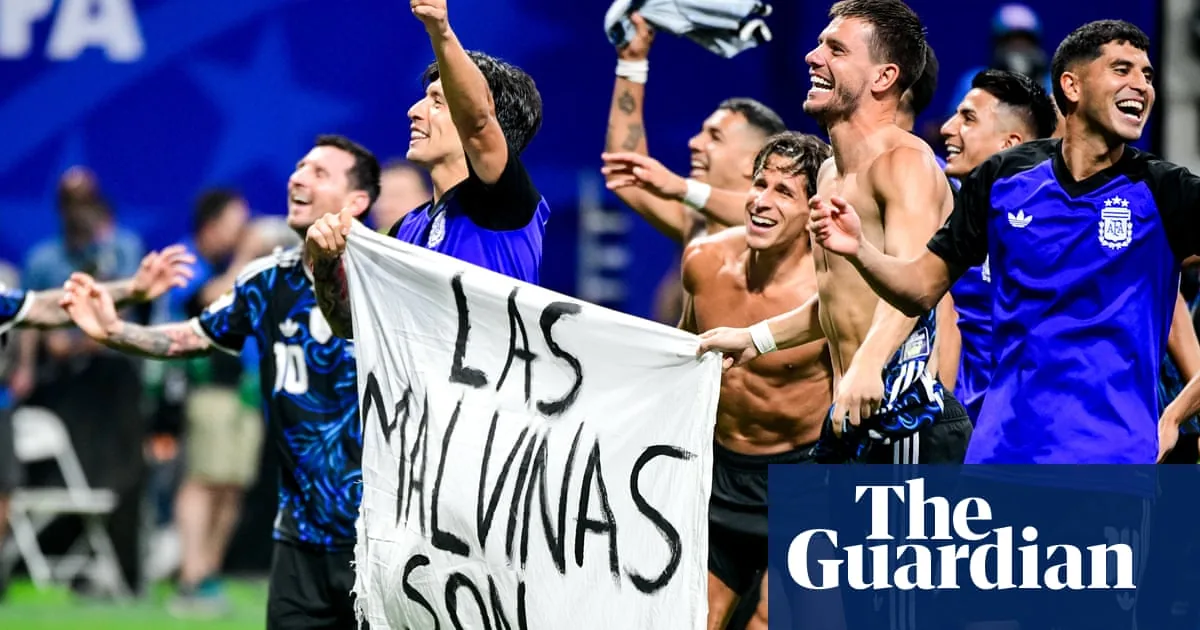

Fifa is currently evaluating match reports following an incident where Argentina players displayed a banner referencing the Falkland Islands after their World Cup semi-final victory against England. The banner, which read “Las Malvinas son Argentinas” (The Falklands are Argentine), was shown after Argentina secured a 2-1 win in Atlanta, setting up a final match against Spain.
A spokesperson for Fifa confirmed that its independent disciplinary committee is reviewing the match reports and relevant circumstances. This assessment will inform any potential further steps, which will be based on the Fifa disciplinary code. The incident has drawn attention due to the ongoing sovereignty dispute between the UK and Argentina over the Falkland Islands, a British overseas territory in the south-west Atlantic Ocean.
The government of the Falkland Islands expressed disappointment regarding the banner, stating a hope that Fifa would “sanction all behaviour of this nature in line with its own rules.” They also emphasised a desire to keep politics separate from sport. Similarly, Downing Street has supported calls for Fifa to investigate the matter, with the prime minister’s official spokesperson asserting the UK’s unwavering commitment to the Falkland Islands.
This is not the first time Argentina‘s football association has faced scrutiny over such a display. In 2014, Fifa fined the association £20,000 for a similar banner shown before a friendly match against Slovenia. At that time, world football’s governing body indicated that the gesture violated rules concerning political action and team misconduct.
Potential disciplinary actions
Fifa typically takes disciplinary action for general breaches of regulations by players or supporters, often in the weeks following a tournament. However, this particular incident, occurring during a World Cup match between the two nations, could be treated with greater seriousness.
Calls for sanctions have emerged from various political figures. Liberal Democrat leader Ed Davey has urged for the Argentina players involved in holding the banner to be suspended from Sunday’s final against Spain. He referenced a precedent set by Uefa, which banned Spain players Alvaro Morata and Rodri for one game after they chanted “Gibraltar is Spanish” during Euro 2024 celebrations.
Another comparable situation involved South Korea midfielder Park Jong-woo, who received a two-match suspension from Fifa after displaying a sign reading “Dokdo is our territory” following the 2012 Olympic Games bronze medal match. Dokdo, also known as Liancourt Rocks, is a group of inlets administered by South Korea, over which Japan also claims sovereignty.
Conservative Party leader Kemi Badenoch and Business and Trade Secretary Peter Kyle have both echoed the sentiment that Fifa should investigate the incident. Kyle emphasised the importance of keeping politics out of the World Cup, describing the banner as an an “egregious violation of the rules.”
Historical context and reactions
The dispute over the Falkland Islands dates back to 1982 when Argentina, then under a military junta, invaded the islands. The conflict lasted 74 days, from April to June 1982, resulting in the deaths of 649 Argentine and 255 British servicemen, along with three islanders. In a 2013 referendum, the people of the Falkland Islands voted overwhelmingly to remain a UK overseas territory, with 1,513 votes in favour and only three against, out of 1,517 cast.
Argentina manager Lionel Scaloni had previously stated that he would not mix football and politics, acknowledging the 1982 conflict as a “very sad period in our history.” He stressed that while remembering those affected, a football match should not be confused with political matters.
After the semi-final, Argentina midfielder Leandro Paredes commented that the Falklands War was a “sad part of our history” and that the match “wasn’t just a football match” for his country. Argentina‘s vice-president, Victoria Villarruel, also posted on social media following the victory, stating that “it wasn’t just another match” and that “The Falklands are Argentine.”
The semi-final match itself was described as occasionally fractious, with England‘s Anthony Gordon scoring first before Enzo Fernandez equalised and Lautaro Martinez secured the win for Argentina in injury time. This adds another chapter to the intense World Cup rivalry between the two nations, which includes the notable “Hand of God” goal by Diego Maradona in 1986.
Fifa‘s independent disciplinary committee is currently assessing the match reports to determine any potential further steps.
Read Also
Source: bbc.com

As News GB's Senior Football Correspondent, Lewis Hartnell reports on the Premier League, the EFL and the England national side for readers across the country. He reported on south-coast football for a regional title. He holds a degree in Sports Journalism from Solent University and completed an NCTJ diploma. Lewis lives in Southampton, where he watches youth football and follows the transfer market. “The week's training ground decides the weekend's headlines.”